

What is the magnetic moment of y30 ferrite magnet?
Aug 13, 2025
As a supplier of Y30 ferrite magnets, I often get asked about the magnetic moment of these remarkable materials. Understanding the magnetic moment of Y30 ferrite magnets is crucial for various applications, from industrial machinery to consumer electronics. In this blog post, I'll delve into the concept of magnetic moment, explain what it means for Y30 ferrite magnets, and explore how it impacts their performance in different scenarios.
What is Magnetic Moment?
Magnetic moment is a fundamental property of a magnet that describes the strength and orientation of its magnetic field. It is a vector quantity, which means it has both magnitude and direction. In simple terms, the magnetic moment indicates how strongly a magnet can attract or repel other magnetic materials and the direction in which its magnetic field is oriented.
The magnetic moment of a magnet is typically measured in units of Ampere - square meters (A·m²) in the SI system. It is related to the number of magnetic dipoles within the magnet and their alignment. A higher magnetic moment generally means a stronger magnetic field and greater magnetic force.
Y30 Ferrite Magnets: An Overview
Y30 ferrite magnets, also known as ceramic magnets, are a type of permanent magnet made from a composite of iron oxide and barium or strontium carbonate. They are widely used due to their low cost, good corrosion resistance, and relatively high magnetic properties. Y30 ferrite magnets fall into the category of hard ferrites, which means they have a high coercivity, allowing them to retain their magnetization even in the presence of external magnetic fields.
These magnets are available in various shapes and sizes, including Ferrite Disc Magnets, Ferrite Arc Magnets, and Ferrite Block Magnets. Each shape is designed to meet specific application requirements, such as providing a concentrated magnetic field in a particular area or fitting into a specific mechanical structure.
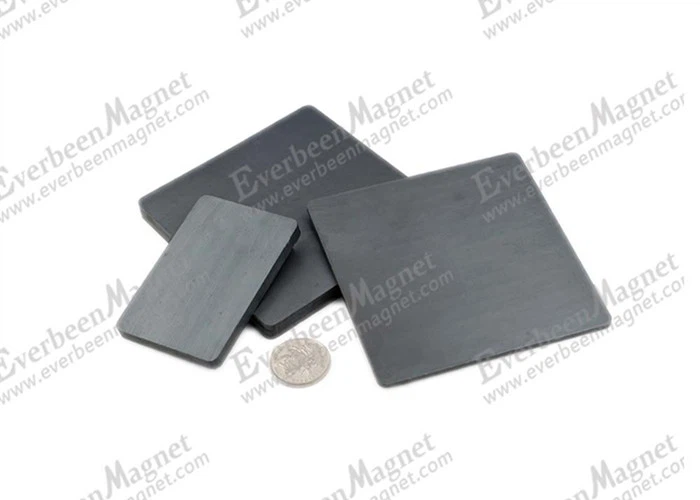

Determining the Magnetic Moment of Y30 Ferrite Magnets
The magnetic moment of a Y30 ferrite magnet depends on several factors, including its volume, magnetization, and the degree of magnetic alignment within the material. The magnetization of a Y30 ferrite magnet is typically expressed in terms of its remanence (Br), which is the magnetic flux density remaining in the magnet after it has been magnetized to saturation and then removed from the external magnetic field.
The magnetic moment (m) of a magnet can be calculated using the formula: m = V × M, where V is the volume of the magnet and M is the magnetization. For Y30 ferrite magnets, the remanence (Br) is related to the magnetization (M) by the equation: M = Br / μ₀, where μ₀ is the permeability of free space (μ₀ = 4π × 10⁻⁷ T·m/A).
To determine the magnetic moment of a specific Y30 ferrite magnet, you first need to know its volume and the remanence value. The volume can be calculated based on the magnet's dimensions, and the remanence value is a characteristic property of the Y30 ferrite material, which is typically in the range of 0.38 - 0.42 T (tesla).
For example, let's consider a Y30 ferrite block magnet with dimensions of 10 mm × 10 mm × 5 mm. The volume of the magnet (V) is:
V = 10 mm × 10 mm × 5 mm = 500 mm³ = 5 × 10⁻⁷ m³
Assuming a remanence (Br) of 0.4 T, the magnetization (M) is:
M = Br / μ₀ = 0.4 T / (4π × 10⁻⁷ T·m/A) ≈ 3.18 × 10⁵ A/m
The magnetic moment (m) of the magnet is:
m = V × M = 5 × 10⁻⁷ m³ × 3.18 × 10⁵ A/m = 0.159 A·m²
Importance of Magnetic Moment in Applications
The magnetic moment of Y30 ferrite magnets plays a crucial role in their performance in various applications. Here are some examples:
Electric Motors and Generators
In electric motors and generators, the magnetic moment of the magnets determines the strength of the magnetic field interacting with the electric current in the coils. A higher magnetic moment results in a stronger magnetic force, which translates into higher torque and power output. Y30 ferrite magnets are commonly used in small - to medium - sized electric motors due to their cost - effectiveness and suitable magnetic properties.
Magnetic Separation
In magnetic separation processes, the magnetic moment of the magnets is used to attract and separate magnetic particles from non - magnetic materials. Y30 ferrite magnets with a sufficient magnetic moment can effectively separate ferromagnetic particles from ores, powders, and liquids, ensuring the purity of the final product.
Magnetic Sensors
Magnetic sensors rely on the interaction between a magnetic field and a sensing element to detect changes in magnetic fields. The magnetic moment of Y30 ferrite magnets can be used to generate a stable magnetic field for sensor applications, such as in proximity sensors, position sensors, and current sensors.
Factors Affecting the Magnetic Moment of Y30 Ferrite Magnets
Several factors can affect the magnetic moment of Y30 ferrite magnets over time:
Temperature
Y30 ferrite magnets have a negative temperature coefficient of remanence, which means that their magnetic properties decrease as the temperature increases. At high temperatures, the thermal energy can disrupt the alignment of the magnetic dipoles within the magnet, leading to a reduction in the magnetic moment. It is important to consider the operating temperature range when using Y30 ferrite magnets in applications.
External Magnetic Fields
Exposure to strong external magnetic fields can demagnetize Y30 ferrite magnets, especially if the external field is in the opposite direction of the magnet's magnetization. Care should be taken to avoid exposing these magnets to excessive external magnetic fields during handling, storage, and operation.
Mechanical Stress
Mechanical stress, such as impact or vibration, can also affect the magnetic moment of Y30 ferrite magnets. High levels of stress can cause micro - cracks or changes in the crystal structure of the magnet, which may lead to a decrease in its magnetic properties.
Quality Control and Testing of Y30 Ferrite Magnets
As a supplier of Y30 ferrite magnets, we ensure the quality and consistency of our products through rigorous quality control and testing procedures. We use advanced magnetic testing equipment to measure the magnetic properties of our magnets, including the magnetic moment, remanence, coercivity, and energy product.
Our testing process involves subjecting the magnets to standardized magnetic fields and measuring the resulting magnetic flux density. This allows us to verify that the magnets meet the specified magnetic properties and performance requirements. We also conduct visual inspections and dimensional checks to ensure the physical quality of the magnets.
Conclusion
In conclusion, the magnetic moment of Y30 ferrite magnets is a critical property that determines their performance in various applications. By understanding the concept of magnetic moment, how it is calculated, and the factors that affect it, you can make informed decisions when selecting Y30 ferrite magnets for your specific needs.
Whether you are in the market for Ferrite Disc Magnets, Ferrite Arc Magnets, or Ferrite Block Magnets, we are here to provide you with high - quality Y30 ferrite magnets that meet your exact specifications. If you have any questions or would like to discuss your requirements, please feel free to contact us for a detailed consultation and procurement negotiation.
References
- "Permanent Magnet Materials and Their Applications" by E. C. Stoner and E. P. Wohlfarth.
- "Handbook of Magnetic Materials" edited by K. H. J. Buschow.
- Manufacturer's datasheets for Y30 ferrite magnets.