


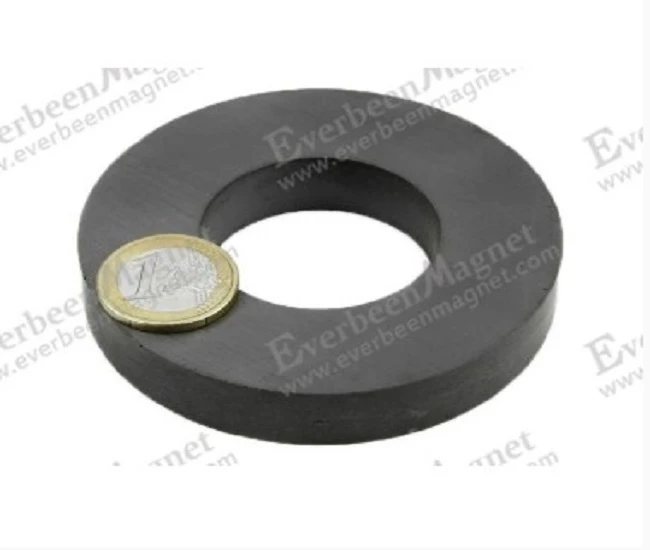
Custom Industrial Ceramic Magnets
We manufacture custom industrial ferrite magnets for OEM manufacturers, motor producers, automation companies, and industrial equipment suppliers. Operating with dedicated pressing tooling and in-house sintering lines, we produce custom geometries, magnetic grades, and magnetization profiles tailored to specific operating temperatures, holding forces, and mechanical tolerances.
Custom Industrial Ceramic Magnets Manufacturer & Wholesale Supplier
We manufacture custom industrial ferrite magnets for OEM manufacturers, motor producers, automation companies, and industrial equipment suppliers. Operating with dedicated pressing tooling and in-house sintering lines, we produce custom geometries, magnetic grades, and magnetization profiles tailored to specific operating temperatures, holding forces, and mechanical tolerances.
Technical Specifications
|
Parameter |
Specification |
|
Material Composition |
Strontium Ferrite (SrO * 6Fe2O3) / Barium Ferrite (BaO * 6Fe2O3) |
|
Magnetic Grades |
Y25, Y30, Y30BH, Y35 (Custom grades available upon request) |
|
Standard Geometries |
Blocks, Arcs, Rings, Discs, Segments, Tiles, and custom profiles |
|
Maximum Operating Temperature |
250°C to 300°C (dependent on grade and aspect ratio) |
|
Density |
4.8 to 5.1 g/cm3 |
|
Surface Treatment |
Typically untreated due to inherent chemical stability; epoxy or parylene coating optional |
|
Magnetization Options |
Axial, Through-Thickness, Radial, Multi-pole face magnetization |
|
Dimensional Tolerance |
Standard grinding tolerance +/- 0.1 mm (tighter tolerances down to +/- 0.05 mm available via CNC diamond grinding) |
|
Quality & Compliance |
ISO 9001:2015 Certified, RoHS and REACH compliant |
Material & Performance Characteristics
Inherent Corrosion Resistance
Unlike NdFeB (neodymium) magnets, ferrite materials are chemically stable ceramic oxides containing no easily oxidized rare-earth elements.
Reason: Because iron is bound tightly within a stable ferrite crystal lattice rather than existing as a free metallic phase, the material does not rust under normal atmospheric conditions.
Application Benefit: Parts operate reliably in humid environments, water pumps, and outdoor machinery without requiring nickel, zinc, or epoxy protective coatings.
Thermal Stability (250°C to 300°C)
Reason: Ferrite magnets possess a low reversible temperature coefficient of remanence (alpha approx -0.2%/°C) and high intrinsic coercivity (Hci) at elevated temperatures compared to standard neodymium grades.
Application Benefit: Maintains stable magnetic output inside continuous-duty electric motors, generators, and heating-adjacent assemblies without permanent thermal demagnetization.
Economic Scalability for High-Volume OEM
Reason: Raw materials (iron oxide and strontium/barium carbonate) are globally abundant and low-cost, avoiding the market volatility of heavy rare-earth elements like dysprosium or terbium.
Application Benefit: Lowers BOM (Bill of Materials) costs for large-scale production runs in consumer appliances, automotive sensors, and magnetic separators.
Customization & Manufacturing Process
We build custom tooling to match assembly housing requirements, eliminating the need to redesign mechanical components around standard catalog sizes.
Raw Material Preparation: Strontium or barium ferrite powders are wet- or dry-milled to achieve controlled particle size distribution.
Compression Molding: Powders are compacted using either isotropic pressing (equal magnetic properties in all directions) or anisotropic wet pressing (aligned in a magnetic field to yield higher energy products such as Y30BH and Y35).
High-Temperature Sintering: Compacts are fired in tunnel kilns at temperatures exceeding 1,200°C to achieve full densification and mechanical rigidity.
Precision Machining: Because sintered ferrite exhibits extreme hardness and brittleness (similar to technical ceramics), dimensions are corrected using diamond-impregnated grinding wheels.
Magnetization & Testing: Components are saturated using high-field impulse magnetizers and verified for surface flux density, residual induction (Br), and coercive force (Hcb).
Industrial Applications
Electric Motors & Actuators: DC permanent magnet motors, starter motors, and brushless actuators utilizing arc segments and rings.
Magnetic Separation Systems: Cross-belt separators, grate magnets, and recycling trommels utilizing deep-field block assemblies.
Acoustic Transducers: Loudspeakers and horn drivers utilizing ring and slug geometries.
Sensors & Reed Switches: Position-sensing rotors and multi-pole encoder rings requiring precise pole pitches.
Quality Control & Inspection Standards
Each production batch undergoes rigorous testing prior to export packaging under strict ISO 9001:2015 quality management systems:
Dimensional Verification: Measured via digital calipers and optical comparators against customer CAD tolerances.
Magnetic Performance Testing: Remanence (Br) and coercivity (Hcb) verified using a Hysteresis Graph or Helmholtz coil testing system.
Visual Inspection: Screened for structural chipping, micro-cracks, and surface inclusions inherent to sintered ceramic processing.
Ordering Workflow & Project Timeline
Submission: Provide 2D/3D drawings (STEP/IGES format), required magnetic grade, target quantity, and working environment conditions.
Feasibility Review: Engineering evaluation of tooling design, pressing shrinkage ratios, and magnetization fixture requirements (Estimated Review Time: 1–2 business days).
Tooling & Prototype Sampling: Custom tooling development, sample production, and delivery for mechanical and magnetic bench-testing (Estimated Lead Time: 2–3 weeks).
Volume & Batch Production: Full-scale manufacturing under fixed process control parameters with Mill Test Reports (MTR) provided upon shipment (Estimated Lead Time: 3–4 weeks).
FAQ
Hot Tags: custom industrial ceramic magnets, China custom industrial ceramic magnets manufacturers, suppliers, factory, consistent magnetic output ceramic magnet, economy ceramic magnets, export ceramic magnet, high performance ceramic magnet, latest ceramic magnet, uses of ceramic magnets


Send Inquiry
